KIIP Pre-Assessment: Format, Scoring and Level Placement
The KIIP placement test: 50 written and 5 spoken questions, score bands for levels 0–5, paper and computer dates for late 2026, and mistakes that cost a level.
On this page08
The KIIP pre-assessment (사전평가) is a placement test, not a pass-or-fail exam. It has 50 written questions in 60 minutes and 5 spoken questions in 10 minutes, scored out of 100. Your score decides which of the six KIIP levels you start in: 81 or more puts you straight into level 5. It costs ₩38,000, the result is valid for two years, and in 2026 you can take it on paper on fixed Saturdays or on a computer on most days of the week in Seoul, Gwangmyeong or Daejeon.
Below: how the test is built and scored, a worked example that shows the one rule that sends strong candidates to level 0, what the official sample paper actually asks, the dates left in 2026, and the mistakes that cost people a level. All details are as of October 2026, from the Ministry of Justice's Socinet site and the evaluation site kiiptest.org, which the Korea Immigration Service Foundation runs for the Ministry.
Do you need to take it?
You need it only if you want to skip levels and have no other proof of your Korean. The alternatives are:
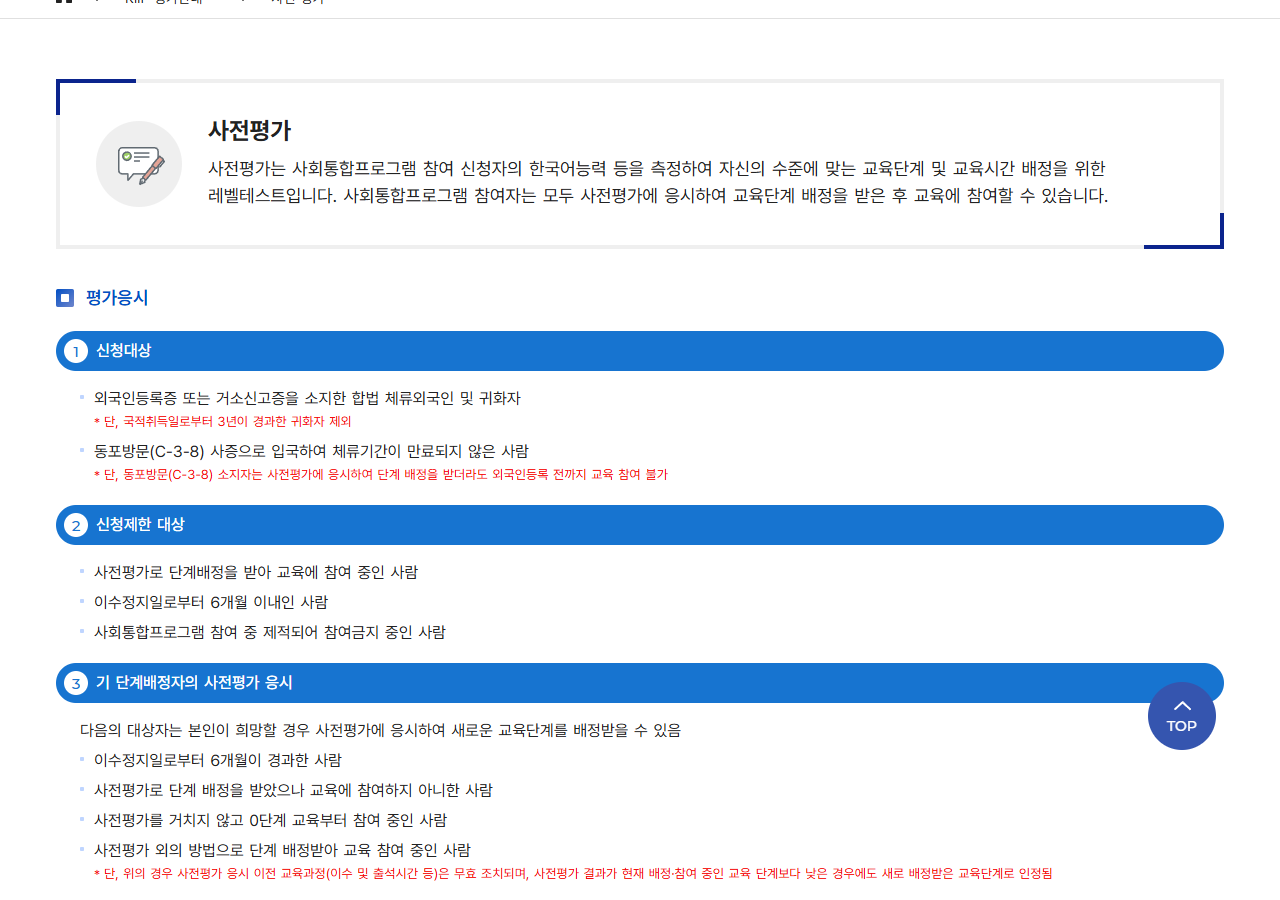 The pre-assessment guide on kiiptest.org (Korea Immigration Service Foundation), October 2026. The page is in Korean only: 신청대상 is who can apply, 신청제한 대상 is who cannot.
- Start at level 0: choose it in Socinet's placement menu, no test.
- TOPIK linkage: a valid TOPIK level 1, 2, 3 or 4–6 places you in KIIP level 2, 3, 4 or 5.
- Marriage visa linkage: F-6 holders who proved basic Korean for their visa can go into level 2.
- Intermediate linkage course: graduates of a registered course at another institution can go straight to the interim evaluation.
Who can sit it: legal residents holding an alien registration card or residence report card, naturalized citizens within three years of naturalization, and C-3-8 visitors whose stay hasn't expired (they can't attend classes until they register). You can't sit it while you are attending classes at a level the pre-assessment gave you, within six months of suspending your studies, or while banned after an expulsion.
Format and scoring
| Part | Questions | Time | Points | How you answer |
|---|---|---|---|---|
| Written: multiple choice, Korean language | 38 | 60 min (whole written part) | 1.5 each | OMR card (paper) or click (computer) |
| Written: multiple choice, culture | 10 | 1.5 each | Same | |
| Written: short answer | 2 | 1.5 each | Written on the back of the OMR card, or typed | |
| Speaking | 5 (read aloud, comprehension, conversation, listen and speak) | 10 min | 5 each | Two examiners score you |
| Total | 55 | 70 min | 100 |
The written part is worth 75 points (50 × 1.5) and the speaking part 25 (5 × 5). Decimals are dropped. The test itself lasts 70 minutes, but the evaluation site warns that with waiting time for the speaking part the day can run three to four hours. On the pre-assessment, two examiners assess five candidates at once in the speaking room.
Placement bands
| Level | 0 | 1 | 2 | 3 | 4 | 5 |
|---|---|---|---|---|---|---|
| Score | 0–2, or speaking under 3 | 3–20 | 21–40 | 41–60 | 61–80 | 81–100 |
Worked example: why the speaking part matters
Take two candidates with the same written result: 36 of 50 correct.
- Candidate A scores 14 of 25 in speaking. Written 36 × 1.5 = 54, plus 14 = 68 → level 4.
- Candidate B freezes and scores 2 in speaking. Written is still 54, total 56. On the score alone that would be level 3, but the band table says anyone under 3 in speaking goes to level 0, whatever the written score.
Candidate B loses three levels to a couple of minutes of silence: levels 0, 1 and 2 add 215 hours of classes (15 + 100 + 100) and, at ₩100,000 each for levels 1 and 2, ₩200,000 in course fees. If you read Korean better than you speak it, practise reading short texts aloud and answering simple questions about yourself before test day.
What the official sample paper asks
The Ministry published a full sample pre-assessment on Socinet. Read question by question, it shows how steeply the difficulty climbs:
- Questions 1–10 start very low: a photo of a handbag with four nouns to choose from, then particles, as in "자야 씨는 몽골( ) 왔어요" (Jaya came ___ Mongolia), then opposites and everyday words like reporting a lost card.
- Questions 11–28 move into intermediate grammar. The later ones ask you to spot the incorrect sentence among four, using patterns such as -더니, -곤 하다 and -(으)ㄹ래야 -(으)ㄹ 수가 없다.
- Questions 29–38 and 47–48 are reading: short diary-style texts first, then passages about renting a flat, workplace manners and job interviews, asking for the main idea or a missing phrase.
- Questions 39–46 are the culture items: which city is not a metropolitan city, what food is served at a baby's 100th-day party, a typical housewarming gift, Korea's UNESCO sites, holiday foods, and how elections work.
- Questions 49–50 are the short answers: you write the missing phrase that finishes a dialogue.
The speaking sample follows the same climb. You read a short travel passage aloud, answer a fact question about it, say where you'd like to travel in Korea, explain what Koreans eat at Seollal and why, and talk about volunteering.
The lesson: the paper is built to spread people across six levels, so nobody is expected to finish it comfortably. Don't panic at the grammar items near the end; the reading and culture questions after them are often easier points.
Paper (PBT) or computer (CBT)
| Paper (PBT) | Computer (CBT) | |
|---|---|---|
| When | 8 fixed Saturdays a year | Most days, in four sessions a day |
| Where | University sites nationwide (14 for the 7th test) | Seoul (Jongno), Gwangmyeong, Daejeon |
| Booking | First come, first served on kiiptest.org | First come, first served, a new round every other Thursday |
| Results | 13 days later, after 4 p.m. | 2 working days later, after 4 p.m. |
| Fee | ₩38,000 | ₩38,000 |
Dates left in 2026. The 7th paper test is on 31 October, with results on 13 November. Registration has closed: it offered 3,145 seats across 14 sites, plus 600 more at Hanyang University in Seoul in an extra round on 15–17 October. The 8th is the last of the year: apply 3–7 November, test 21 November, results 4 December. Dates can change, so check the notice board on kiiptest.org.
On computer, round 23 opens for booking at 9 a.m. on 22 October and closes at midnight on 28 October. Seoul and Gwangmyeong test Monday to Friday; Daejeon tests Friday to Monday. Each day has four sessions, with written tests starting at 9:30, 11:10, 13:40 and 15:20. Check-in opens 30 minutes before the written test and closes 10 minutes before it (9:00–9:20 for the 9:30 session); latecomers are not let in and the fee is not refunded.
For paper tests, the entry window is 12:00–12:30, and nobody is let in after 12:30.
Mistakes that cost people a level
- Taking the computer test twice. Your newest result replaces the old one even if it is lower. The Foundation's own example: 45 points (level 3) one day, 40 (level 2) the next, and you are placed in level 2.
- Mixing paper and computer. If you sit both, the result announced later decides your level, not the better one.
- Booking the wrong test. If you are due for the interim evaluation and book a pre-assessment instead, the new placement replaces everything you have already done.
- Re-sitting after you have started classes. You can, after a six-month suspension or if you never started, but your earlier hours are cancelled and the new level stands even if it is lower.
- Outdated Socinet details. If your address or visa changed and Socinet doesn't know, the booking page won't let you past "next step". Update your details on Socinet first (My Page → member details → address change / status change).
- Wrong ID. Only the original alien registration card, resident registration card, passport, Korean driving licence or a residence permit confirmation with photo is accepted. Copies, photos and mobile IDs are refused, and the fee is not refunded.
- Letting the result lapse. It is valid for two years from the result date. After that you are removed and must be placed again.
The 85-point shortcut
If you score 85 or more, you can sit the permanent residence evaluation within two years without taking any classes. Passing it that way satisfies the basic knowledge requirement for permanent residence, but it is not KIIP completion: the pass certificate is marked "not completed" until you also finish the level 5 basic course. If you are aiming for citizenship rather than permanent residence, read the naturalization evaluation guide before choosing this route.
Results appear on My Page on Socinet and on kiiptest.org. Nobody calls or texts you with the score. To book, you need accounts on both sites; the Socinet guide covers that part.
Frequently asked questions
04What score do I need on the KIIP pre-assessment to start at level 5?
81 points or more out of 100. The bands are 3–20 for level 1, 21–40 for level 2, 41–60 for level 3, 61–80 for level 4 and 81–100 for level 5. Anyone who scores under 3 on the speaking part is placed in level 0, whatever their written score.
Do I have to take the KIIP pre-assessment?
No. You can start at level 0 without it, or be placed through a valid TOPIK result, a marriage-visa language certificate or a registered intermediate course elsewhere. The pre-assessment is how you skip levels if you have none of those.
How long is a KIIP pre-assessment result valid?
Two years from the result date. If you don't start a course at your level in that time, the placement lapses and you have to be placed again.
Can I go straight to the permanent residence test from the pre-assessment?
Yes, if you score 85 or more. You can then sit the permanent residence evaluation within two years without taking classes. Passing it that way satisfies the basic knowledge requirement for permanent residence but does not count as completing KIIP.
Sources
- KIIP evaluation site — Pre-assessment guide, format and placement bands (Korean)
- Socinet — KIIP evaluations: pre-assessment, interim and comprehensive (Korean)
- Socinet notice — 2026 KIIP evaluation schedule (Korean, HWP attachment)
- Korea Immigration Service Foundation — 7th pre-assessment registration, October 2026 (Korean)
- Korea Immigration Service Foundation — 7th pre-assessment extra registration, October 2026 (Korean)
- Korea Immigration Service Foundation — CBT pre-assessment and comprehensive evaluation, round 22 (Korean)
- Socinet notice — Official sample questions: pre-assessment and interim evaluation (Korean)
- Ministry of Justice — KIIP participants' FAQ, August 2026 edition (Korean)
Written by
Mokdongnyeok· Editor
Lives in Gyeonggi-do, just north of Seoul, and writes practical guides to the Korean exams foreigners take — walking through each registration screen, working through the official past papers and checking every fee, format and score rule against the official source.
How these guides are madeRelated articles
04How to Register for TOPIK in Korea: Step by Step on topik.go.kr
What each TOPIK sign-up and registration screen asks for, the 10:00–16:00 window, fees (₩40,000/₩55,000), Korean-only payment and the photo rules.
8 minTOPIK Levels and Score Bands Explained: What Level 1 to 6 Mean
TOPIK I gives level 1–2, TOPIK II gives level 3–6, decided by your total score. Official cut-offs for paper and IBT, worked examples and what each level means.
6 minTOPIK Test Day: What to Bring, ID Rules and the Timetable
Which IDs TOPIK accepts in Korea, when doors close (09:20 / 12:20), the minute-by-minute timetable, the watch and phone ban, and answer-sheet rules.
7 minHow to Sign Up on Socinet and Apply for a KIIP Course
A screen-by-screen guide to Socinet, the Korean-only KIIP site: sign-up, placement, course applications, the waitlist, fees and booking tests on kiiptest.org.
7 min